
This project was completed in collaboration with Schibsted and IN/LAB, and was later featured in Reuters and Journalism.co.uk. NDA note: some technical details and proprietary data have been simplified or omitted to comply with my NDA. All reflections and framing here are my own and don't represent an official Schibsted position.
Tailoring Transparency for Journalism
Tailoring Transparency for Journalism
Timeline
3 months
Role
Product Designer (AI & Editorial Tools)
Team
Schibsted × IN/LAB
Publication
Published in Journalism.uk and INLAB, KTH DIVA Publication
BACKGROUND
The core business reality of modern media is that the business cannot run without the efficiency of AI. Still, the business cannot survive without the ethics of editorial trust.
PROBLEM
As newsrooms rapidly adopt Generative AI to stay competitive, they face a historic ''invisible'' trust crisis.
PROBLEM
As newsrooms rapidly adopt Generative AI to stay competitive, they face a historic ''invisible'' trust crisis.
INSIGHTS
The Emergence of the Paradox
When newsrooms try to solve these problems by forcing rigid disclaimers, they trigger the Paradox of Disclosure: both concealing AI involvement and over-explaining AI math actively drive down user trust.

This paradox sits on top of 5 systemic pillars that hold it up
Cognitive Fatigue
Too much AI detail creates cognitive fatigue, not confidence.
Human Expectation
Users generally expect journalism to be human, and AI disclosure can inadvertently erode this illusion of authorship
Editorial Control
Newsroom's ability to manage and oversee the involvement of AI in content creation
AI Litracy
Many readers don’t understand how AI works.
Verifiability
Even with human oversight, users crave auditability.
Cognitive Fatigue
Too much AI detail creates cognitive fatigue, not confidence.
Human Expectation
Users generally expect journalism to be human, and AI disclosure can inadvertently erode this illusion of authorship
Editorial Control
Newsroom's ability to manage and oversee the involvement of AI in content creation
AI Litracy
Many readers don’t understand how AI works.
Verifiability
Even with human oversight, users crave auditability.
SOLUTION
Designing the Dual-Sided Trust Loop
To dismantle the Paradox of Disclosure and break down its five systemic pillars, I designed a dual-sided trust loop. Before launching the redesign, we mapped the operational workflow to understand where trust was breaking down.
News Interface (Consumer Experience)
In the consumer-facing product, I made solutions for 2 subsidiaries of Schibsted- Aftonbladet Chatbot and Omni's summary(connected to the CMS solution above)- to address the paradox of disclosure to users


Aftonbladet
Omni News
How it worked
Aftonbladet- Hej Afton is Aftonbladet’s AI chatbot powered by GPT-4o and verified archives—handling news, sports, and entertainment in 50 languages.
Omni- Users could glance at the summaries generated by AI without opening the article.
What's wrong though
Aftonbladet
Traceability: Users cannot see how the AI arrives at its answers, what information it considers, or prioritized.
Tone and Voice: The chatbot offers a single, non-adjustable response style with no tone options.
Omni
Static AI Disclaimers: One-size-fits-all warnings slapped on articles regardless of news sensitivity, triggering cognitive fatigue and user suspicion with no way to flag mistakes, correct biases, or influence model training.

How it worked
The Click: The journalist wrote or pasted their article in the CMS editor, then clicked a generic "Generate" button.
The Behind-the-Scenes: This action sent the text directly to OpenAI's API to automatically produce the summary or fact box.
The Publication: Once generated, the AI output was dropped directly onto the publication canvas and editors could publish it.
What's wrong though?
There no intermediate verification checkboxes, traceability tools, or review panels, the journalist simply clicked "Save/Publish", sending the unverified machine content straight onto Aftonbladet's live feed with zero human-in-the-loop validation.
Suggested features

AI Impact Score – Shows how much AI shaped a story.
Editable Disclosure – Lets editors adjust the tone of transparency.
Auto Disclosure toggle – Gives control back to editors over disclousre.
Source Links – Provide direct traceability to AI sources.
Impact Box – Visually signals when AI had major influence.
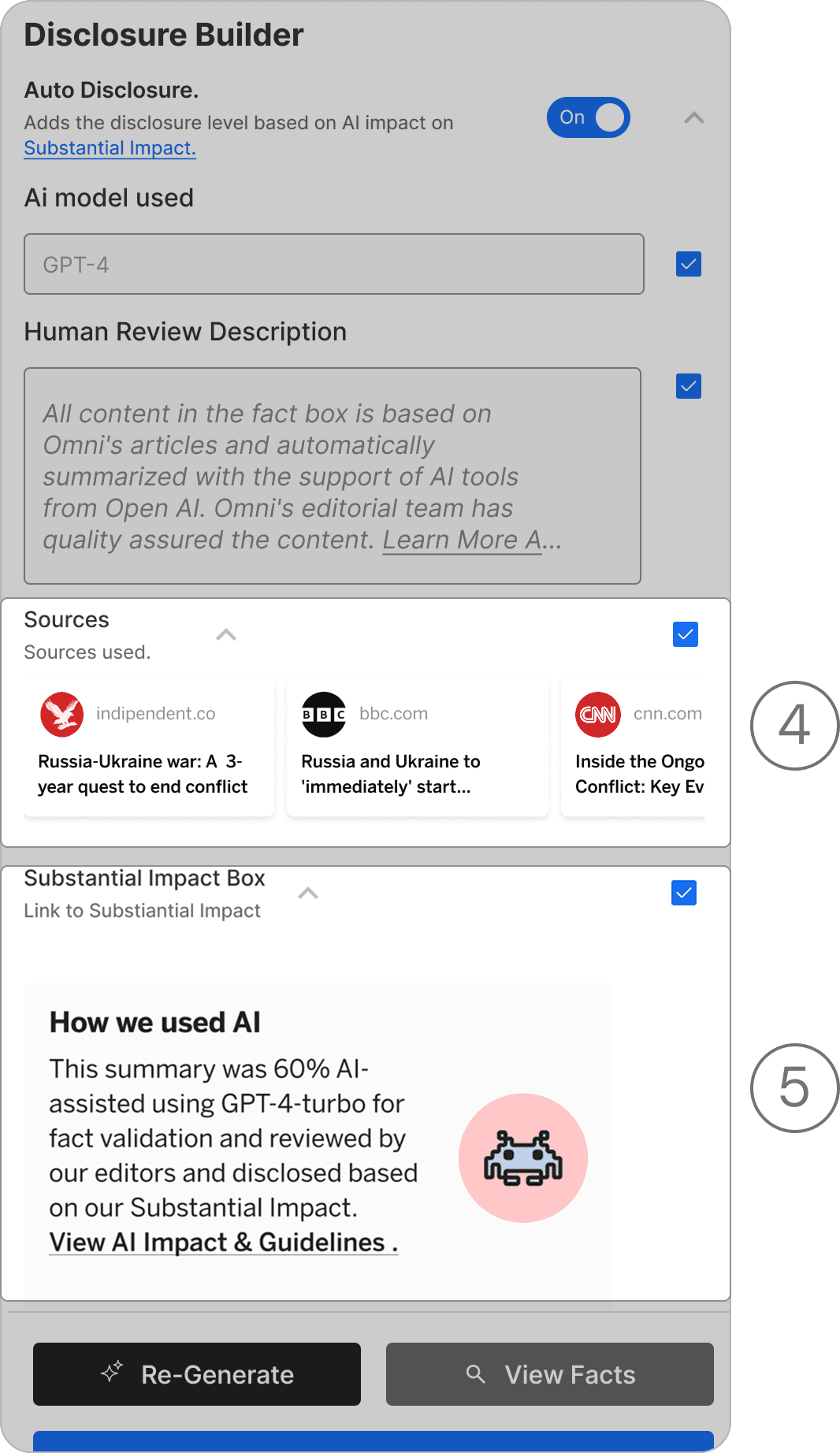
The following example is where AI's impact was most evident in the story: editors can now add sources to the disclaimer. Also, an impact box which tells users how we use AI


User testing verdict
Technical Fatigue: Hard metrics like "68% AI impact" felt overly technical; readers needed descriptive labels.
Dismantling the Pillars:
Editorial Control: Journalists can customise disclosure depth or override automatic settings depending on whether the story is sensitive crime reporting or a routine sports score.
Verifiability: Editors can trace summary points back to original interview logs in real-time, catching biases before they are published.
After state Aftonbladet
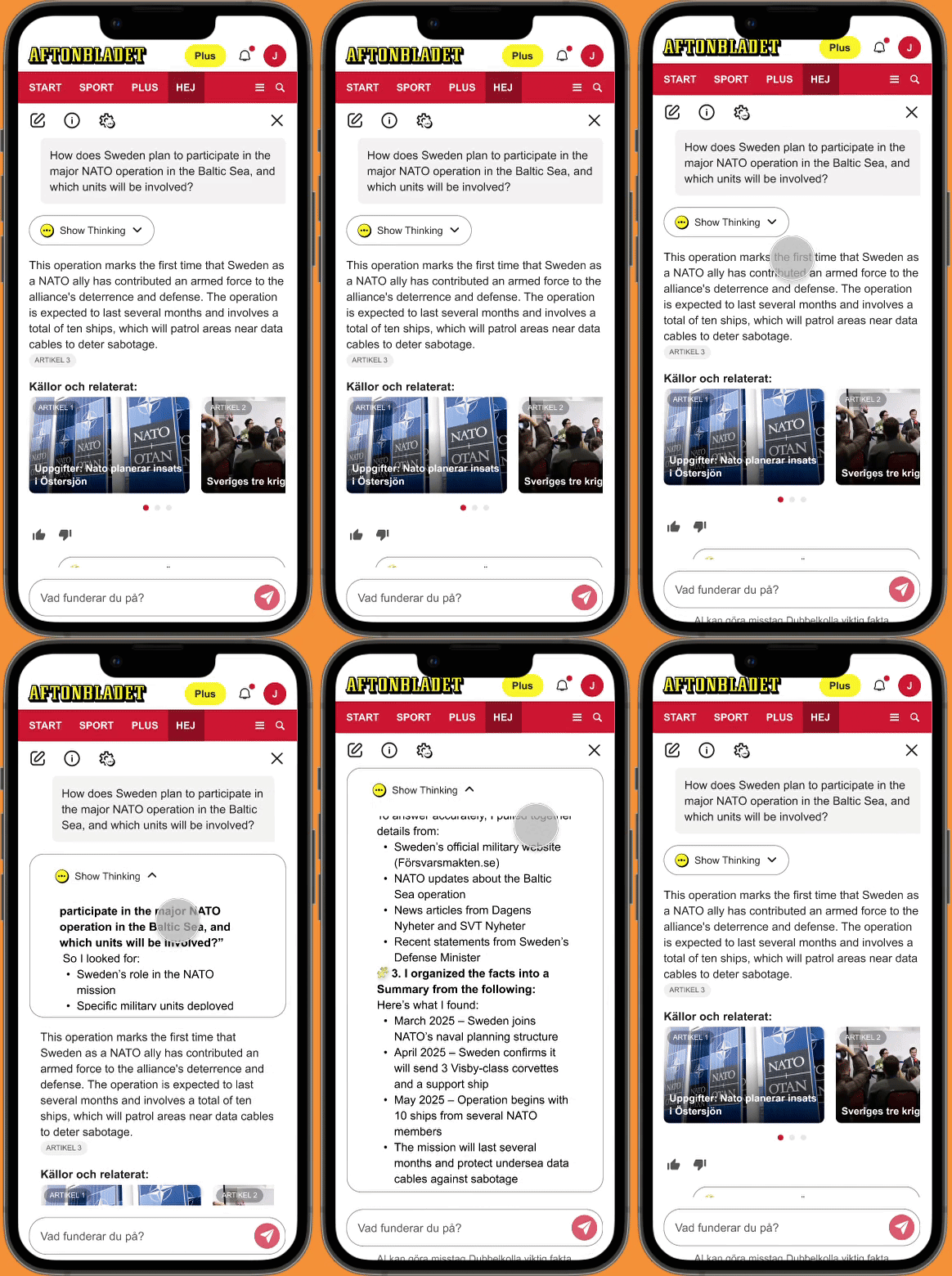

Show thinking Pill (Chain of Thought)
Chatbot Settings
How it works
Show thinking Pill (Chain of Thought) gives a glimpse of how AI thinks and is used for complex queries.
Chatbot settings to filter trusted sources and preferred formats. Users may not see how filters affect results, and stronger safeguards are needed to prevent unclear or excessive content control.
Dismantling the pillars
Show Thinking Pill
AI Literacy: Instead of forcing users to understand complex machine learning models, the "Show Thinking" pill provides a human-readable glimpse into how the AI arrives at its conclusions. It shows the logical reasoning steps in real-time, matching the reader's natural mental model.
Cognitive Fatigue: By hiding the complex reasoning chain behind a lightweight, expandable "pill," casual readers get a clean, direct answer immediately, while analytical power users can expand the trace only when they want to.
Verifiability: Exposing the step-by-step logic proves to the reader that the AI is relying on verified journalistic source materials rather than fabricating facts out of thin air
Chatbot Settings
Human Expectation: Giving readers the agency to select their own source boundaries flips their relationship with the AI from passive consumption to active curation. It builds immediate trust because the user controls the source constraints.
After state Omni
Feedback to feed into AI
Progressive Disclosure


Progressive Disclosure
How it works
Interactive Feedback Loop: Integrated inline controls on AI summaries, allowing readers to submit real-time corrections and qualitative ratings that directly train and fine-tune future model runs.
Fact-Level Citations & AI Impact Dashboard: Embedded explicit source links for every stated fact alongside an "AI Impact" indicator that visually communicates the exact level of machine intervention (e.g., "Mostly AI-written").
Dismantling the pillars
Human Expectations: Designed inline feedback controls for readers to submit real-time corrections, fulfilling the human expectation for editorial control while actively fine-tuning future AI models.
Verifiability: Embedded explicit source links and an "AI Impact" visual indicator for every fact, dismantling the "black box" through clear auto-disclosure and verifiability.
Feedback to feed into AI
Progressive Disclosure
IMPACT
By shifting from technical jargon to contextual, human-centred design, the framework successfully dismantled the Paradox of Disclosure
Drove Engagement & Readership:
Disproved "cannibalisation" fears by proving that AI summaries lowered upfront cognitive load, which actively deepened overall article read times.
Defined Industry Standards:
Authored the widely quoted research, "The Paradox of Disclosure", setting a Scandinavian reference standard for designing AI transparency and trust.
Operationalized Data Ethics:
Led cross-functional alignment across 9 newsrooms and AI expert panels, bridging the gap between abstract AI ethics and daily editorial workflows.
LEARNINGS
Design Learnings & Iterations
Simplify Disclosure Labels: Progressive disclosure works, but technical metrics (e.g., "AI Impact: 68%") must be simplified to plain-text tags (e.g., "Mostly AI-written"). Source links also require higher UI visibility to ensure true auditability.
Streamline the "Chain of Thought": Revealing the AI's logic demystifies decision-making and builds trust, but raw data overwhelms users. It requires simpler language, cleaner visuals, and stricter guardrails to be accessible.
Define Explicit Content Boundaries: Users value format flexibility (text, audio, video), but the UI must explicitly distinguish AI-generated content from human-reviewed content and mandate editor approvals for all variations.
Rethink Trust KPIs: Trust cannot be measured by raw traffic or macro growth. Success must be evaluated using trust-correlated metrics like repeat readership, app store ratings, and qualitative surveys.

Wanna ride this wave with me?
Hit me up!
Wanna ride this wave with me?
Hit me up!
Tailoring Transparency for Journalism
Timeline
3 months
Role
Product Designer (AI & Editorial Tools)
Team
Schibsted × IN/LAB
Publication
Published in Journalism.uk and INLAB, KTH DIVA Publication
BACKGROUND
The core business reality of modern media is that the business cannot run without the efficiency of AI. Still, the business cannot survive without the ethics of editorial trust.
PROBLEM
As newsrooms rapidly adopt Generative AI to stay competitive, they face a historic ''invisible'' trust crisis.
INSIGHTS
The Emergence of the Paradox
When newsrooms try to solve these problems by forcing rigid disclaimers, they trigger the Paradox of Disclosure: both concealing AI involvement and over-explaining AI math actively drive down user trust.
This paradox sits on top of 5 systemic pillars that hold it up
Cognitive Fatigue
Too much AI detail creates cognitive fatigue, not confidence.
Human Expectation
Users generally expect journalism to be human, and AI disclosure can inadvertently erode this illusion of authorship
Editorial Control
Newsroom's ability to manage and oversee the involvement of AI in content creation
AI Litracy
Many readers don’t understand how AI works.
Verifiability
Even with human oversight, users crave auditability.
SOLUTION
Designing the Dual-Sided Trust Loop
To dismantle the Paradox of Disclosure and break down its five systemic pillars, I designed a dual-sided trust loop. Before launching the redesign, we mapped the operational workflow to understand where trust was breaking down.
News Interface (Consumer Experience)
In the consumer-facing product, I made solutions for 2 subsidiaries of Schibsted- Aftonbladet Chatbot and Omni's summary(connected to the CMS solution above)- to address the paradox of disclosure to users
Aftonbladet
Omni News
How it worked
Aftonbladet- Hej Afton is Aftonbladet’s AI chatbot powered by GPT-4o and verified archives—handling news, sports, and entertainment in 50 languages.
Omni- Users could glance at the summaries generated by AI without opening the article.
What's wrong though
Aftonbladet
Traceability: Users cannot see how the AI arrives at its answers, what information it considers, or prioritized.
Tone and Voice: The chatbot offers a single, non-adjustable response style with no tone options.
Omni
Static AI Disclaimers: One-size-fits-all warnings slapped on articles regardless of news sensitivity, triggering cognitive fatigue and user suspicion with no way to flag mistakes, correct biases, or influence model training.
How it worked
The Click: The journalist wrote or pasted their article in the CMS editor, then clicked a generic "Generate" button.
The Behind-the-Scenes: This action sent the text directly to OpenAI's API to automatically produce the summary or fact box.
The Publication: Once generated, the AI output was dropped directly onto the publication canvas and editors could publish it.
What's wrong though?
There no intermediate verification checkboxes, traceability tools, or review panels, the journalist simply clicked "Save/Publish", sending the unverified machine content straight onto Aftonbladet's live feed with zero human-in-the-loop validation.
Suggested features
AI Impact Score – Shows how much AI shaped a story.
Editable Disclosure – Lets editors adjust the tone of transparency.
Auto Disclosure toggle – Gives control back to editors over disclousre.
Source Links – Provide direct traceability to AI sources.
Impact Box – Visually signals when AI had major influence.
The following example is where AI's impact was most evident in the story: editors can now add sources to the disclaimer. Also, an impact box which tells users how we use AI
User testing verdict
Technical Fatigue: Hard metrics like "68% AI impact" felt overly technical; readers needed descriptive labels.
Dismantling the Pillars:
Editorial Control: Journalists can customise disclosure depth or override automatic settings depending on whether the story is sensitive crime reporting or a routine sports score.
Verifiability: Editors can trace summary points back to original interview logs in real-time, catching biases before they are published.
After state Aftonbladet
Show thinking Pill (Chain of Thought)
Chatbot Settings
How it works
Show thinking Pill (Chain of Thought) gives a glimpse of how AI thinks and is used for complex queries.
Chatbot settings to filter trusted sources and preferred formats. Users may not see how filters affect results, and stronger safeguards are needed to prevent unclear or excessive content control.
Dismantling the pillars
Show Thinking Pill
AI Literacy: Instead of forcing users to understand complex machine learning models, the "Show Thinking" pill provides a human-readable glimpse into how the AI arrives at its conclusions. It shows the logical reasoning steps in real-time, matching the reader's natural mental model.
Cognitive Fatigue: By hiding the complex reasoning chain behind a lightweight, expandable "pill," casual readers get a clean, direct answer immediately, while analytical power users can expand the trace only when they want to.
Verifiability: Exposing the step-by-step logic proves to the reader that the AI is relying on verified journalistic source materials rather than fabricating facts out of thin air
Chatbot Settings
Human Expectation: Giving readers the agency to select their own source boundaries flips their relationship with the AI from passive consumption to active curation. It builds immediate trust because the user controls the source constraints.
After state Omni
Feedback to feed into AI
Progressive Disclosure
How it works
Interactive Feedback Loop: Integrated inline controls on AI summaries, allowing readers to submit real-time corrections and qualitative ratings that directly train and fine-tune future model runs.
Fact-Level Citations & AI Impact Dashboard: Embedded explicit source links for every stated fact alongside an "AI Impact" indicator that visually communicates the exact level of machine intervention (e.g., "Mostly AI-written").
Dismantling the pillars
Human Expectations: Designed inline feedback controls for readers to submit real-time corrections, fulfilling the human expectation for editorial control while actively fine-tuning future AI models.
Verifiability: Embedded explicit source links and an "AI Impact" visual indicator for every fact, dismantling the "black box" through clear auto-disclosure and verifiability.
IMPACT
By shifting from technical jargon to contextual, human-centred design, the framework successfully dismantled the Paradox of Disclosure
Drove Engagement & Readership:
Disproved "cannibalisation" fears by proving that AI summaries lowered upfront cognitive load, which actively deepened overall article read times.
Defined Industry Standards:
Authored the widely quoted research, "The Paradox of Disclosure", setting a Scandinavian reference standard for designing AI transparency and trust.
Operationalized Data Ethics:
Led cross-functional alignment across 9 newsrooms and AI expert panels, bridging the gap between abstract AI ethics and daily editorial workflows.
LEARNINGS
Design Learnings & Iterations
Simplify Disclosure Labels: Progressive disclosure works, but technical metrics (e.g., "AI Impact: 68%") must be simplified to plain-text tags (e.g., "Mostly AI-written"). Source links also require higher UI visibility to ensure true auditability.
Streamline the "Chain of Thought": Revealing the AI's logic demystifies decision-making and builds trust, but raw data overwhelms users. It requires simpler language, cleaner visuals, and stricter guardrails to be accessible.
Define Explicit Content Boundaries: Users value format flexibility (text, audio, video), but the UI must explicitly distinguish AI-generated content from human-reviewed content and mandate editor approvals for all variations.
Rethink Trust KPIs: Trust cannot be measured by raw traffic or macro growth. Success must be evaluated using trust-correlated metrics like repeat readership, app store ratings, and qualitative surveys.
Wanna ride this wave with me?
Hit me up!